How Much Is an Automatic Cat Feeder?
Automatic cat feeders usually cost from about 30 dollars to over 150 dollars, with most simple timed models sitting in the budget to mid-range band. Extra features like app control, cameras and cooling push the price up.
On this page (8 sections)
- How much is an automatic cat feeder at each price level?
- What features push the price up?
- Do you need to pay more for a feeder that won't jam?
- Which automatic cat feeder gives the best value?
- Are automatic feeders bad for cats?
- What else adds to the running cost?
- How much should you spend for two cats?
- Which automatic cat feeder should you buy at each budget?
An automatic cat feeder usually costs about 30 dollars to over 150 dollars, and most simple timed models sit in the budget to mid-range band. The price depends on what the feeder does: basic timed meals are cheap, while app control, cameras and cooling add a lot.
The answer is the same whether you feed one cat or two. What changes the cost most is the feature set, so it helps to know which features you actually need before you shop.
How much is an automatic cat feeder at each price level?
Budget feeders cost roughly 30 dollars to 60 dollars, mid-range models about 60 dollars to 100 dollars, and premium feeders over 100 dollars. The jump between levels comes from control and monitoring, not from the basic job of dropping kibble on time.
At the budget end you get a timer, portion settings and a voice recording. Those feeders do the core job well for short trips.
Mid-range models usually add a sturdier lid, a bigger tank and a battery backup that lasts longer. Premium feeders add app scheduling, cameras and sometimes cooling for wet food.
For most homes, the mid-range band covers scheduled meals without paying for features you won't use.
What features push the price up?
App and Wi-Fi control, cameras and wet food cooling are the big price drivers. Each one adds convenience or monitoring, so it costs more than a plain timed feeder.
A camera lets you watch your cat eat from your phone. Cooling keeps wet food fresh for a set time.
App control means you can change a meal from anywhere. These features help some households a lot and matter little to others.
If you're usually home and only need backup feeding, a simple timer is the better buy. Our guide to automatic cat feeders with a timer covers the models built around exactly that job.
One detail worth checking when you compare timers: portion size. Portions are not the same across brands.
The PETLIBRO feeder measures a portion at about 2.5 teaspoons, while the VOLUAS feeder dispenses about 6 to 7g per portion. A feeder that looks cheaper per meal may just be dropping a smaller portion, so read the portion size, not only the price.
Do you need to pay more for a feeder that won't jam?
No, a higher price doesn't guarantee jam-free feeding. Anti-jam design is a feature you can find at several price levels, so read what each model does rather than assume price equals reliability.
PETLIBRO's feeder uses an infrared anti-jam safety stop that cuts power when it senses an obstruction. ANDOLL HOME describes a food swinging device that keeps kibble moving into the bowl.
These are design choices, not price tiers. If jams are your main worry, read why my automatic cat feeder is jammed for the usual causes before spending more.
What food size keeps a feeder running smoothly?
Most jams come from kibble outside the feeder's size range. PETLIBRO lists a recommended food size of 2 to 15mm.
It also lists simple checks when food stops coming out: confirm the food size, clean the container and base, clean the detector at the outlet, then set a manual feed and check whether the rotor turns. Running those checks takes minutes and saves a service call or a return.
A feeder that handles your cat's kibble size matters more than a higher price tag.
Which automatic cat feeder gives the best value?
The VOLUAS Automatic Cat Feeder is our top pick for most homes because it covers timed meals, portion control and battery backup without app extras. Its 4L tank holds 16.9 cups and sets 1 to 4 meals a day.
The portion range runs 0 to 40 choices per meal, at about 6 to 7g each. It runs on a 5V adapter or 3 D-cell batteries, so a power cut doesn't stop a meal.
A 10-second voice recording plays at mealtime. For most readers this is the sensible spend: it handles the core job and the backup.
Best for hands-off schedules: ANDOLL HOME Automatic Cat Feeder
ANDOLL HOME suits a household that wants steady food flow and a comfortable bowl angle. It has a food swinging device to keep kibble moving and a lid opening device at the top that discourages stealing.
The bowl tilts 8 degrees for a comfortable eating position. A 10-second voice recording plays three times at each meal.
Power comes from a 5V adapter or 3 AA batteries as backup. It's a 4L tank, so it suits one or two cats on a short trip.
The finger lid opening device at the top helps keep a clever cat from lifting the lid and helping itself between meals.
Best for more meal slots: PETLIBRO Automatic Cat Feeder
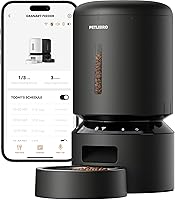
PETLIBRO suits a household that wants more meal slots and tighter freshness control. It sets up to 6 meals a day, each from 1 to 50 portions at 2.5 teaspoons each.
A twist-lock lid, sealing strip and included desiccant bag keep kibble fresh. The battery backup runs about 30 to 50 days on 3 D-cell batteries.
The infrared anti-jam stop adds safety when a cat paws at the outlet. The 6 meal slots help if your cat does better with several small meals spread across the day.
Are automatic feeders bad for cats?
No, a well-set automatic feeder is safe for most cats. The risks come from setup and portions, not from the feeder itself.
Portion control is the main benefit: you decide how much goes out at each meal. The main risk is overfeeding if the portion size is set too high.
Another is a feeder that jams and leaves a cat without food. Our post on whether automatic feeders are bad for cats walks through the real concerns and how to avoid them.
Set meals to match your cat's daily food amount and test the feeder before your first trip. A voice recording also helps a cat adjust to a feeder, since mealtime comes with a familiar sound.
What else adds to the running cost?
Batteries and desiccant bags are the ongoing costs. Both are small, but they're worth planning for.
Most feeders use 3 D-cell or AA batteries as backup. They only drain when the power is out or when the feeder runs on batteries alone.
Desiccant bags keep kibble dry and need replacing now and then. A feeder with a sealing lid and a fresh desiccant bag keeps food in better shape, which matters if you fill the tank less often.
Budget a little each year for both.
Battery type varies by model, so check before you stock up. PETLIBRO takes 3 D-cell batteries.
VOLUAS also takes 3 D-cell batteries. ANDOLL HOME takes 3 AA batteries.
Buying the wrong size is a common first-week mistake.
How long does a full tank actually last?
Tank life depends on the number of cats and the portions you set. PETLIBRO estimates its tank lasts about 12 days for one cat and about 4 days for a medium sized dog.
That gives you a rough sense of how much food a full tank holds. For two cats, expect the food to go about twice as fast.
A bigger tank means fewer refills, which is worth paying a little more for if you travel often.
How much should you spend for two cats?
Plan for a mid-range feeder with a bigger tank when you feed two cats. More cats means more food used each day, so tank size matters as much as price.
Two cats eat through a 4L tank faster than one, which means more refills. A model that dispenses reliably and holds a full tank suits that setup better than a cheap unit that jams.
Our guide to the best automatic cat feeder for 2 cats covers models built for shared feeding. Pick a feeder with anti-jam design and a solid lid so both cats get their meals.
The lid matters with two cats, since a curious cat may try to nose the lid open when the other is eating.
Which automatic cat feeder should you buy at each budget?
For a budget spend, choose a simple timed model and add batteries and a desiccant bag. For a mid-range spend, the VOLUAS Automatic Cat Feeder is the best all-rounder, with 4 meals a day and battery backup.
For more meal slots and tighter freshness control, the PETLIBRO feeder earns its price. For smooth food flow and a tilted bowl, the ANDOLL HOME model fits.
The real question of how much is an automatic cat feeder worth spending comes down to your trips. If you're away often, pay for reliable backup and a bigger tank.
If you're rarely gone overnight, a basic timer covers it. Check the product page for the exact current price before you order.
Frequently asked questions
How much is an automatic cat feeder on average?
Most automatic cat feeders land in the budget to mid-range band, roughly 30 dollars to 80 dollars for a timed model with portion control and a voice recording. App-connected and camera models cost more, often above 100 dollars.
Do automatic cat feeders need batteries?
Most models run on a wall adapter and use batteries only as backup during a power outage. A few small feeders run on batteries alone.
Check the power setup before you buy, since battery life affects running cost.
Is a cheap automatic cat feeder worth it?
A budget feeder is worth it if you only need reliable timed meals and portion control. Spend more when you want app scheduling, a camera, or cooling for wet food.
Simple timed models cover most everyday away-from-home feeding.
What makes an automatic cat feeder more expensive?
App and Wi-Fi control, built-in cameras, wet food cooling, and larger food tanks raise the price. Basic timed feeders with a twist-lock lid and battery backup stay cheaper while covering the core job of feeding on schedule.
How much should I budget for a first automatic cat feeder?
Budget for a mid-range timed feeder plus a set of backup batteries and a desiccant bag. That setup covers scheduled meals during short trips without paying for app features you may not use every day.