Best Automatic Cat Feeders Without WiFi
The best automatic cat feeder without WiFi is one you can program at the unit in seconds and trust through a power cut. A simple timer feeder covers most homes better than an app-connected model.
On this page (6 sections)
An automatic cat feeder without WiFi runs its whole schedule from buttons on the unit. That makes it the simpler, sturdier choice for most homes, because there is no app to learn, no router to reach and no password to forget.
You set the meals once and the feeder keeps them.
The feeders here also keep feeding when the power goes out. A timer unit with a battery backup sits quietly in the kitchen and dispenses the same portions at the same times, whether or not your internet is up.
The best pick for most readers is the VOLUAS, thanks to its flexible power options and 4L hopper. Read on for how each model fits a different routine.
Why choose an automatic cat feeder without WiFi?
A WiFi-free feeder gives you the same reliable meal times with fewer things to go wrong. The clock lives in the feeder, so a dropped connection or a router reboot changes nothing.
Consider what a networked feeder needs. It needs a 2.4GHz band your router must broadcast, a working app on your phone, and a connection that stays up while you are away.
A timer feeder needs none of that.
It also handles travel better. A cat sitter can press a button to feed an extra portion without knowing your login details.
You can leave written instructions on the fridge and they will actually work.
The trade-offs are real too. You cannot change a meal from another city, and you will not get a phone alert if a meal is missed.
For some owners that remote control matters. If you want to watch and adjust from your phone, our automatic cat feeder with timer roundup covers the models built around scheduled meals, and the app-feeder category covers the connected ones.
One more point in their favor: fewer electronics means fewer failure points. A feeder with a dial or a small screen tends to keep working for years because there is so little to fail.
The ANDOLL HOME makes this plain in its own pitch, saying its product's function is not unique but its design from build to daily use is meant to be the most pet friendly. That is the appeal of the whole category in one sentence.
The units here also keep the food itself in better shape than an open bowl. Each hopper seals with a lid and holds a desiccant, so the kibble a cat eats at hour twelve tastes closer to the kibble poured at hour one.
Pick a non-WiFi feeder if you want set-and-forget feeding and you are not chasing remote control.
What to check before you buy a non-WiFi feeder?
Check four things: the portion size, the number of meals, the backup power and the food storage. Get those right and the feeder will fit your cat's routine without surprises.
Portion size and meals per day
Portion sizes differ between brands, so read the numbers rather than assuming. The VOLUAS dispenses about 6–7g per portion, roughly 1 tbsp.
The PETLIBRO uses 2.5 teaspoons per portion and allows 1 to 50 portions per meal. The ANDOLL HOME does not state a gram figure, so compare its bowl output with your cat's current servings.
Meals per day matter just as much. The VOLUAS allows 1 to 4 meals.
The PETLIBRO allows up to 6 meals, which suits small, frequent servings. If your cat eats twice a day, the VOLUAS schedule is plenty.
The ANDOLL HOME does not publish a meal count, so its listing leaves you to check the screen at setup.
Battery backup and power source
Every model here runs on mains power and takes batteries as a backup. The VOLUAS and ANDOLL HOME each take 3 batteries (D-cell and AA respectively), and the PETLIBRO takes 3 D-cell batteries.
That backup keeps the schedule running through a brief outage.
Think about where the feeder will sit. A spot near an outlet is best, because batteries are backup, not the main supply.
A feeder that loses power with no batteries will miss meals until you reset it. The PETLIBRO's listing puts its D-cell backup life at about 30 to 50 days, which tells you how long a set lasts when it is only carrying the schedule rather than the motor.
Hopper size and food freshness
The VOLUAS and ANDOLL HOME each hold 4L. The PETLIBRO's 4L hopper feeds a cat for about 12 days, according to the brand.
That is long enough for a two-week trip with a sitter checking in. The PETLIBRO's own guidance adds a second figure for larger pets, noting a full hopper lasts about 4 days for a medium sized dog.
All three include a desiccant spot. That matters more than the liter count, because dry kibble stays crisp when air is kept out.
Keep the lid sealed and change the desiccant as the maker advises. The ANDOLL HOME goes a step further with a desiccant box that the brand says isolates the air to keep food from getting damp or moldy, and it includes one desiccant to start.
Kibble size and jam risk
Small or oddly shaped kibble is the usual cause of a jam. The PETLIBRO states a 2 to 15 mm food range, so measure a handful of your cat's food against that.
Our guide to why my automatic cat feeder is jammed walks through the fixes. The PETLIBRO's own troubleshooting list starts with food size, then cleaning the container and base, then cleaning the outlet detector, and finally a manual feed to check the rotor turns.
Pick the feeder whose portion size and meal count match your cat's current diet, then confirm the battery backup.
Best automatic cat feeders without WiFi
These three feeders cover the main household needs: outage protection, fussy kibble and long schedules. The VOLUAS is the best pick overall because it combines the largest score, a 4L hopper, wired or battery power and a 10-second voice recording.
VOLUAS Automatic Cat Feeder: best for power outages
The VOLUAS earns the top spot for one practical reason. It takes a fixed 5V USB adapter or 3 D-cell batteries, so a power cut does not stop the schedule.
Most feeders in this price band treat batteries as an afterthought; here they are a stated second power path.
Its schedule is easy to reason about. You set between 1 and 4 meals and 0 to 40 portions each.
One portion is about 6–7g, so a 40-portion meal is a large serving and 1 portion is a light snack. That spread covers most cats without needing an app.
The voice recording adds a personal touch. You get 10 seconds to call your cat at mealtime, which the feeder plays when food drops.
Owners of shy cats often find this helps them come to the bowl.
A 4L hopper holds 16.9 cups. The LCD screen makes setup simple, and the removable parts can be washed.
Its 3.7 lb body and 11 x 7 x 7 inch footprint fit under a counter edge. The 16.9-cup figure works out to roughly 48 teaspoons per cup, so you can count portions against the hopper if you like to plan a trip in advance.
The main limit is that 4 meals per day is the ceiling. If your vet wants six small servings, look at the PETLIBRO instead.
For households with two cats sharing one unit, read our automatic cat feeder for 2 cats guide.
Pick the VOLUAS if outages worry you and twice-daily meals fit your cat.
ANDOLL HOME Automatic Cat Feeder: best for fussy kibble shapes
The ANDOLL HOME targets the most common feeder complaint: food that will not drop. Its design uses a food-swinging device and a distribution system meant to keep kibble moving into the bowl instead of sticking at the outlet.
That matters if your cat eats a small or irregular kibble. A feeder that stalls leaves your cat hungry and you troubleshooting from a distance.
The swing device is the brand's answer to that. The brand's own framing is blunt about the problem, asking whether you have had food fail to come out or found yourself shaking the feeder to get it flowing.
The lid is another practical detail. A finger-press opening on top helps stop a determined cat from prying it up and stealing food between meals.
A desiccant box sits inside to keep the food dry, and one desiccant is included.
The bowl tilts 8 degrees, which gives your cat a more natural eating angle. The voice feature records 10 seconds and plays it three times at each meal.
Power comes from a 5V DC adapter or 3 AA batteries as backup. The triple playback is a small detail with real value for a cat that ignores a single call.
Its 4L hopper matches the VOLUAS. The body measures 12 x 7 x 13 inches and weighs 3.84 lb.
The AA batteries are smaller and easier to find than D-cells, though they may need changing more often. The taller 13-inch body means more clearance needed above the lid than the VOLUAS asks for.
The catch is that the brand does not publish a gram figure per portion. Watch the first few meals to learn how much food your cat gets.
Our post on whether automatic feeders are bad for cats covers overfeeding and how to avoid it.
Pick the ANDOLL HOME if your cat's kibble has jammed other feeders or your cat raids the hopper.
PETLIBRO Automatic Cat Feeder: best for multi-meal schedules
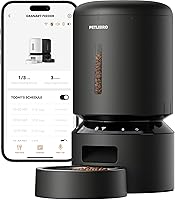
The PETLIBRO suits cats that eat several small meals. It allows up to 6 meals a day and 1 to 50 portions per meal, with 2.5 teaspoons per portion.
That flexibility covers everything from a light snack to a full dinner. The brand's own breakdown puts one portion at about 20ml, a twelfth of a cup, four teaspoons or 0.35oz, which makes it easy to compare against a wet food label.
Its anti-jam protection is the standout safety feature. An infrared sensor cuts power when something blocks the outlet, which protects the motor and your cat's paws.
That is a step beyond a simple timer.
Food freshness gets real attention too. A patent rotor, a twist-lock lid and a sealing strip work with the desiccant bag to keep kibble crisp.
The brand says a full hopper feeds a cat for about 12 days.
Power comes from USB-C or 3 D-cell batteries. The brand says the batteries last about 30 to 50 days as backup.
A 10-second voice message plays at each meal. The listing also carries first-use guidance worth reading before you fill it: dry food only, check the accessories are complete, and note that it is not recommended for kittens under 3 months old or for large dogs.
The limits are small. Its portions are lighter than the VOLUAS at 2.5 teaspoons, so you may need more portions for the same meal size.
It is also the lowest score here, because the smaller portions mean more setup tuning for a hungry cat.
The anti-jam sensor and 6 meals make it the strongest fit for cats on a frequent small-meal plan. Measure your kibble against the 2 to 15 mm range before ordering.
Pick the PETLIBRO if your cat eats several small meals and you want jam protection built in.
How do the three feeders compare?
The comparison comes down to schedule flexibility and jam protection versus raw capacity and backup simplicity. All three feed dry food on a timer without any network.
| Feature | VOLUAS | ANDOLL HOME | PETLIBRO |
|---|---|---|---|
| Hopper | 4L | 4L | 4L |
| Meals per day | 1 to 4 | Not stated | Up to 6 |
| Portion size | About 6–7g | Not stated | 2.5 tsp |
| Power | USB adapter or 3 D-cell | 5V adapter or 3 AA | USB-C or 3 D-cell |
| Voice call | 10 seconds | 10 seconds | 10 seconds |
| Anti-jam feature | No | Food-swinging device | Infrared safety stop |
The VOLUAS wins on backup simplicity and larger portions. The ANDOLL HOME wins on jam prevention for awkward kibble.
The PETLIBRO wins on meal count and the infrared stop.
For a single cat on two meals a day, the VOLUAS is the easy choice. For a cat on four or more small meals, the PETLIBRO's 6-meal ceiling matters more than the bigger VOLUAS portions.
The battery format is the third sorting point: D-cells in the VOLUAS and PETLIBRO stretch longer between changes, while the ANDOLL HOME's AA cells are the ones already in most kitchen drawers.
How do you set up and run a timer feeder without WiFi?
Set the clock first, then the meals, then fill the hopper. The order matters, because a feeder with the wrong time feeds at the wrong hour.
Start by placing the unit on a level surface near an outlet. Leave room around the lid and the bowl so your cat can eat without bumping the feeder.
Plug in the adapter and fit the backup batteries before you program anything.
Set the current time on the screen. Then set each meal time and portion count.
The VOLUAS lets you set 0 portions for a meal you do not want, so you can leave a slot empty. Run a test feed to confirm the portion size before the first scheduled meal.
Fill the hopper with dry food only. Seal the lid and fit the desiccant.
Watch the first two or three meals to check the portions land as expected, then adjust the count up or down. On the ANDOLL HOME, press the top lid closed firmly so the finger-press catch engages, since that latch is what keeps the food in and the cat out.
A few habits keep it running well. Wipe the bowl daily and wash the removable parts weekly.
Check the outlet and batteries monthly. If food stops dropping, the usual causes are stale kibble, a loose lid or a blocked outlet, and our jam guide covers each fix.
Keep the feeder where your cat can reach it but a dog cannot. A raised spot or a corner helps.
If the feeder sits on carpet, check that it stays level after a bump.
Set the time and a test feed before the first real meal, then leave the schedule alone for a week.
Which feeder fits your household?
The VOLUAS is the pick for most homes, because its battery backup and 4L hopper handle trips and outages without fuss. The ANDOLL HOME is the better buy when kibble jams are your main worry or your cat raids the lid.
The PETLIBRO wins when your cat needs several small meals a day and you want an infrared safety stop.
Think about your cat's current diet first. Count the meals and measure a typical portion.
A feeder that cannot match those numbers will need constant tuning.
Then think about your trips. If you leave for a weekend or longer, battery backup and a big hopper matter more than a voice call.
If you are home most days, the schedule is what counts.
If you have two cats, one feeder may not be enough. Our guide to the best automatic feeder for 2 cats covers the units that feed both without a fight.
And if you are unsure about timer feeding at all, read are automatic feeders bad for cats before you buy.
An automatic cat feeder without WiFi is the low-drama choice: set it once and it keeps the routine. Pick the VOLUAS for backup power and capacity, the ANDOLL HOME for awkward kibble, or the PETLIBRO for frequent small meals.
That one decision covers nearly every household.
Frequently asked questions
Do automatic cat feeders need WiFi to work?
No. A timer feeder runs its whole schedule from buttons and an LCD screen on the unit, with no network connection at all.
WiFi only matters if you want to change meals or watch your cat from a phone.
Can a non-WiFi feeder keep running in a power cut?
Yes, if it takes batteries as well as mains power. The VOLUAS and ANDOLL HOME models both run on 3 batteries as backup, and the PETLIBRO uses 3 D-cell batteries that it says last about 30 to 50 days.
What food size suits an automatic feeder without WiFi?
Dry kibble only. The PETLIBRO says its food should fall within 2 to 15 mm, so measure your cat's kibble before ordering.
Wet food belongs in a separate bowl or a cooled wet food feeder.
How long does the food in a 4L feeder stay fresh?
The PETLIBRO says a full hopper feeds a cat for about 12 days. The VOLUAS holds 4L, or 16.9 cups, and the ANDOLL HOME also holds 4L.
Each unit includes a desiccant spot to keep kibble dry.
Is a WiFi-free feeder harder to set up?
It is usually easier. You set the clock and meals on the LCD screen in one short sitting.
There is no account, router band or app update to deal with, and no password to remember.